Choose Aligned or Staggered Dots for a Nail Pattern
Compare aligned and offset rows of nail dots while keeping their size and colors similar, then discuss how the repeat fits your design at YLG.
Leer en español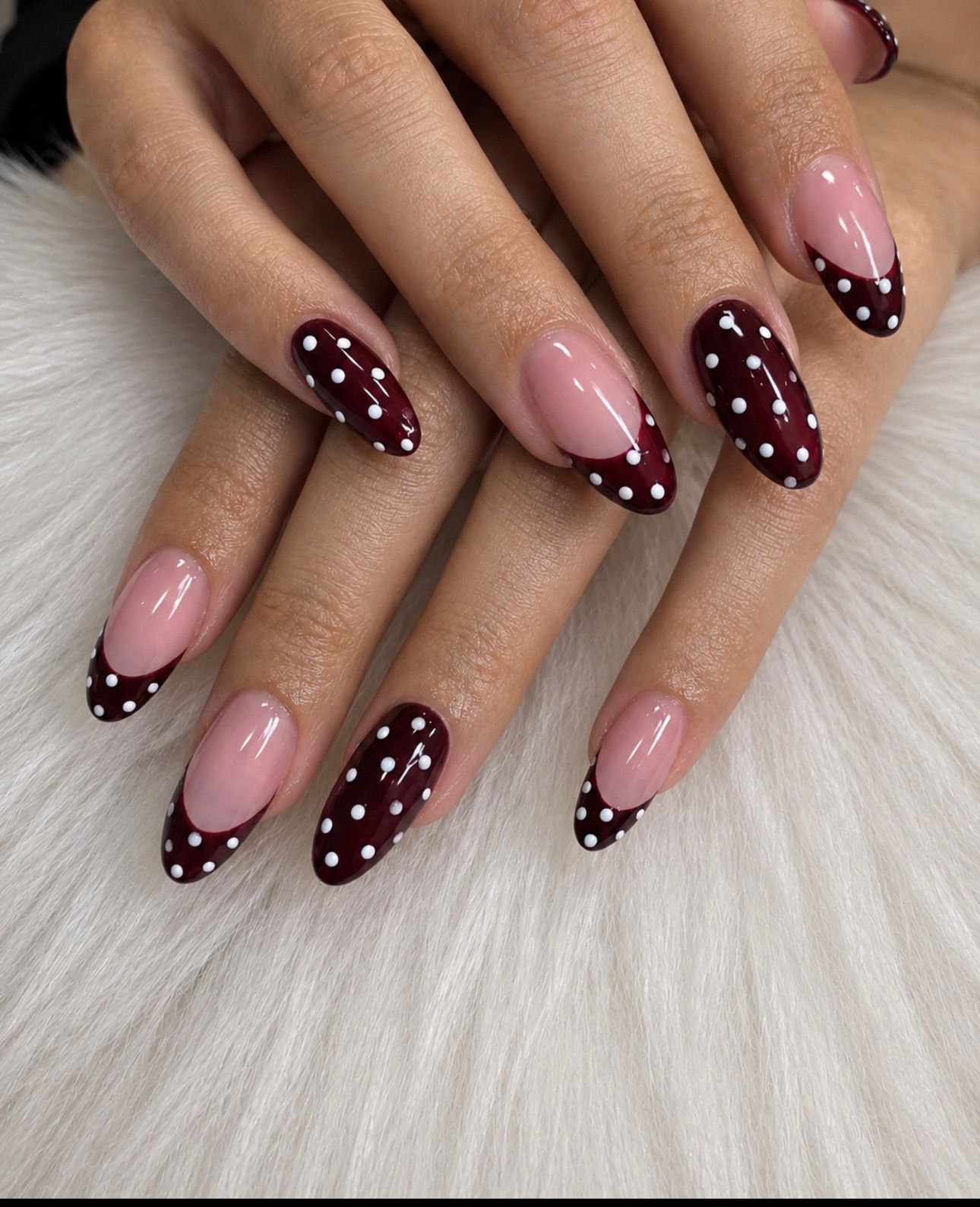
“White dots over burgundy” names the colors and motif, but it leaves the arrangement open. Do you picture dots lined up in rows and columns, or alternate rows shifted so the dots sit between those above them? Comparing those two layouts can make a polka-dot request more specific.
Look for alignment between rows
In an aligned layout, corresponding dots in neighboring rows sit on the same imaginary lines. In a staggered layout, one row is offset from the next. You can use either arrangement with the same dot color and background.
Choose an area of your reference where several dots are visible together. Looking at one dot alone will not show the pattern's alignment. If perspective or reflections make the arrangement hard to read, keep it as a question for the consultation.
Try a small repeat on paper
Draw two rectangles and add three short rows of equally sized dots to each. On the first, line the dots up into columns. On the second, shift the middle row sideways so its dots fall between the positions in the rows above and below.
Keep the dot size, colors and distance between rows similar. The purpose is to compare alignment, not to make one version larger or more crowded. These simple diagrams describe a visual preference; they do not specify how to apply a nail product.
Account for the edge of the design area
A rectangular diagram will not fit every nail or curved tip exactly. When a row approaches the edge, discuss whether you prefer fewer complete dots or a pattern that appears to continue beyond that boundary. Mark the area where you want the repeat to stop.
You do not need to demand a mathematically exact grid. Ask the artist how the chosen arrangement could adapt to the available space while keeping the repeat recognizable.
Point to the pattern you mean
The YLG cover photograph shows white dots on burgundy areas beside pink sections. It offers a real dotted-design reference, but it is not a diagram of two perfectly measured layouts. Look at the dots separately from the bright reflected streaks on the surface.
A clear request might be: “I like these colors and small dots. Please compare aligned rows with offset rows in the decorated area, and keep the dot size similar.” That gives you one specific difference to discuss before choosing the final arrangement.
Add the selected layout to your design brief. Check the YLG service catalog, confirm which service and design fit your appointment, and reserve your visit.